All the ways to pray
I enjoy launching into different mediums to uncover the storytelling of a text. This is a process which encourages me to play with the words and explore my first responses through visual language. Often it reveals the pathway forward for the illustrations to emerge and reveal themselves.
Preliminary sketching is key for me. As with writing, where it is important to work through several drafts, the first illustrations when responding to a new text also need space to develop.
Responding to Kathleen’s manuscript for ‘All the ways to pray’ for the first time, I began creating a sketchbook full of illustrations inspired from my own experiences with children in a learning environment. In my professional experience with school children over the years I have been fortunate to observe the unique body languages and personal mannerisms that each child might present as they share their learning spaces.


Next, I felt compelled to zoom in on the main character and get to know her in an enlarged colour rough. I am longing to know who these characters will become and how their personalities might shape the storytelling. This process often yields key characteristics and visual elements that resonate with the text.
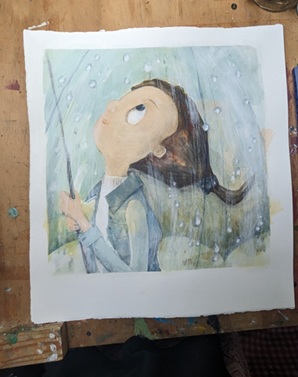
The first colour rough reveals a close up image of the main character as she stands in the rain. As she reflects on her willingness ‘to be positive and open to the good things that will happen in her ‘Good Day Prayer’, she is immediately affirmed by her positive and adaptive thinking for remembering to carry her umbrella on the way to school.
I like the implication of uncertainty associated with this image of nature and weather. We often face uncertainty in our daily experiences. Unexpected changes bring new challenges. How will we adapt to the unforeseen road blocks and twists and turns of the day?
The author scaffolds the setting of the story through the daily routines of her main character. This is a clever way to present a variety of experiences that our young readers can connect to in familiar environments.
Once the coloured roughs are all approved the fun begins with the finished artwork. A lot of time is taken in the sizing and scale of the rough drawings before the paper is prepared with under painted layers.

I use mixed media in my finished artwork. The underpainting is usually a mixture of goauche and watercolour mediums. Layers of watercolour, ink, gouache and coloured pencil are all used to create the finished illustration. I don’t draw the illustration on the paper and then colour in the detail. I work the whole image as a painting using underpainted background spaces and then I add layers on top of each layer to develop the details. This way the image has a consitent depth, connected saturation and unified colour across the image. I really like this process because it allows me a lot of freedom to adjust smaller details as needed and allows me to use looser brush marks across the surface.

This gentle book is an invitation to choose happy and embrace reflective and positive thinking in our daily routines.
Kathleen’s text calmly embraces the joy of learning. It focuses on developing an appreciation for the best things in our lives including the challenging moments that present themselves when least expected.
 Each page shows the potential we can turn to through the guiding principles of reflection and gratitude. Wether in the classroom, in the yard or at home, embracing healthy and positive mindsets strengthens our communities and promotes balance, strength and wellbeing.
Social and emotional learning for our young readers provide vital life skills for successful social interactions. This beautiful and reflective book opens conversations with early readers as they learn to regulate positive choices and appreciate the power of gratitude and prayer along the way.
